

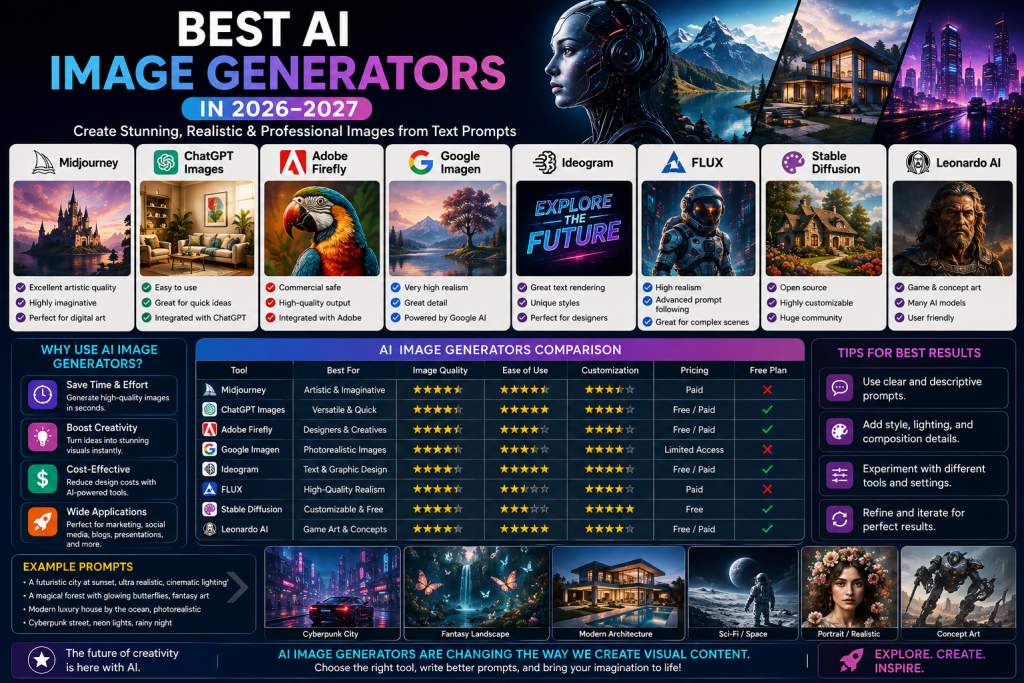
AI image generators have completely changed the way designers, marketers, content creators, businesses, and students create visual content. Instead of spending hours designing an image from scratch, you can now describe an idea in natural language and generate a detailed image within seconds.
In 2026, AI image generation has become more advanced than ever. Modern AI tools can create photorealistic images, digital artwork, product photography, social media graphics, illustrations, posters, marketing visuals, concept art, and even edit existing images.
But with so many AI image generators available, an important question remains:
Which is the best AI image generator in 2026–2027?
In this guide, we compare some of the best AI image generators in 2026–2027, their major features, strengths, limitations, and the type of users they are best suited for.
What Is an AI Image Generator?
An AI image generator is a software tool that uses artificial intelligence to create images based on text prompts, reference images, sketches, or other instructions.
For example, you could enter a prompt such as:
“A futuristic city in India at night, neon lights, cinematic photography, ultra-detailed, 4K.”
The AI model interprets the description and generates an image based on your instructions.
Modern AI image generators can be used for:
- Website images
- Blog featured images
- Social media posts
- YouTube thumbnails
- Product photography
- Advertisements
- Digital artwork
- Illustrations
- Posters
- Logos and brand concepts
- Concept designs
- Marketing campaigns
- Educational graphics
This makes AI image generation useful for both beginners and professional creators.
Best AI Image Generators in 2026–2027
Here are some of the leading AI image-generation tools worth considering in 2026–2027.
1. Midjourney – Best for Creative and Artistic Images
Midjourney is one of the most popular AI image-generation platforms for creating highly stylized and visually impressive artwork.
It is particularly useful when you want cinematic scenes, fantasy artwork, concept art, fashion visuals, character designs, environments, and creative illustrations.
Why Choose Midjourney?
Midjourney is especially strong at:
- Artistic image generation
- Cinematic visuals
- Fantasy artwork
- Character concepts
- Product concepts
- Fashion photography
- Creative compositions
- Highly detailed environments
If your main priority is visual quality and artistic style, Midjourney remains one of the strongest options to consider.
Best For
Designers, artists, photographers, content creators, and creative professionals.
2. ChatGPT Images – Best for Easy AI Image Creation and Editing
AI image generation inside ChatGPT makes image creation more conversational. Instead of learning complicated controls, users can describe what they want and refine the result through natural-language instructions.
This is particularly useful when you want to generate an image and then make several changes without starting from scratch.
For example, you can ask the AI to:
- Change the background
- Remove an object
- Add another person
- Change colors
- Modify clothing
- Create a different composition
- Convert an image into another style
- Improve an existing image
This conversational workflow makes AI image generation accessible to beginners.
Best For
Beginners, bloggers, marketers, students, designers, and everyday users.
3. Adobe Firefly – Best AI Image Generator for Designers
Adobe Firefly is a strong choice for people already working with Adobe’s creative ecosystem.
Firefly can generate and edit images from text prompts and provides tools for creating marketing visuals, social media content, illustrations, product images and other creative assets.
Adobe also emphasizes commercially safe generative AI workflows, which can be important for businesses and professional creators.
Firefly also provides access to multiple AI models within its workflow, including Adobe’s own models and partner models.
Best Features
- Text-to-image generation
- Image-to-image workflows
- Generative Fill
- Image editing
- Style customization
- Creative Cloud integration
- Marketing content creation
Best For
Graphic designers, agencies, marketers, and Adobe Creative Cloud users.
4. Google Imagen – Best for Photorealistic AI Images
Google’s Imagen family focuses heavily on high-quality text-to-image generation.
Google describes its latest Imagen 4 model as capable of photorealistic images, detailed textures, diverse artistic styles, and improved text rendering. Imagen 4 can generate images at up to 2K resolution.
You can use Imagen through Google’s AI ecosystem, including Gemini and other Google AI tools.
Best For
- Photorealistic images
- Landscapes
- Portraits
- Product concepts
- Creative illustrations
- Detailed visual scenes
Best For
Creators who want realistic and detailed AI-generated images.
5. Ideogram – Best for Text in AI-Generated Images
One of the biggest challenges with AI image generation has traditionally been creating accurate text inside images.
Ideogram has become a popular option for designs where typography is important.
It can be particularly useful for:
- Posters
- Advertisements
- Social media graphics
- Headlines
- Signs
- Promotional designs
- Logo concepts
- Typography-based artwork
If your project needs an image with readable text, Ideogram is worth testing alongside other AI image generators.
Best For
Graphic designers, marketers, social media creators, and businesses.
6. FLUX – Best for Photorealistic and Advanced AI Workflows
FLUX is another important name in the AI image-generation space.
It is particularly interesting for creators and developers who want high-quality image generation and more control over their workflows.
FLUX-based models can be used for:
- Photorealistic images
- Creative artwork
- Product visuals
- Concept art
- Character designs
- Experimental AI workflows
Different FLUX models and access options are available, so users should check the current licensing and commercial-use terms before using a particular model in a business project.
Best For
Advanced creators, developers, and AI enthusiasts.
7. Stable Diffusion – Best for Customization and Local AI
Stable Diffusion remains an important choice for users who want more control over their AI image-generation workflow.
Unlike simple online AI generators, locally hosted models can provide greater customization and privacy, depending on the setup.
Advanced users can experiment with:
- Custom models
- Fine-tuning
- LoRAs
- Control workflows
- Image-to-image generation
- Local generation
- Custom styles
However, local AI generation generally requires more technical knowledge and suitable computer hardware.
Best For
Developers, AI enthusiasts, researchers, and advanced creators.
AI Image Generators Comparison
| AI Image Generator | Best For | Main Strength |
|---|---|---|
| Midjourney | Creative artwork | Artistic quality |
| ChatGPT Images | Easy creation & editing | Conversational workflow |
| Adobe Firefly | Designers | Adobe ecosystem |
| Google Imagen | Realistic images | Photorealism |
| Ideogram | Text in images | Typography |
| FLUX | Advanced users | Flexible AI workflows |
| Stable Diffusion | Customization | Local & custom workflows |
How to Choose the Best AI Image Generator?
There is no single AI image generator that is perfect for everyone.
The best tool depends on what you want to create.
For Graphic Designers
Adobe Firefly and Midjourney are strong options for creative workflows.
For Beginners
ChatGPT Images is a convenient choice because you can describe changes using natural language.
For Artistic Images
Midjourney is a strong option for cinematic, artistic, and imaginative visuals.
For Text-Based Designs
Ideogram is worth considering when accurate text is an important part of the image.
For Photorealistic Images
Google Imagen and FLUX are worth testing for realistic image-generation workflows.
For Advanced AI Users
Stable Diffusion and FLUX can provide greater flexibility for users comfortable with technical AI workflows.
Best Free AI Image Generators in 2026
If you are looking for a free AI image generator, several platforms offer free access or limited free credits.
However, free plans can change frequently. They may include limitations such as:
- Daily generation limits
- Monthly credits
- Lower resolution
- Slower generation
- Watermarks
- Limited editing features
- Restricted commercial usage
Always check current pricing and licensing information before using AI-generated images commercially.
Adobe Firefly, for example, currently offers a free starting option, while its features and credits depend on the plan and service configuration.
How to Create Better AI Images With Prompts
The quality of your AI-generated image often depends on how clearly you describe your idea.
Instead of writing:
“A car.”
Try:
“A futuristic electric sports car driving through a modern city at night, cinematic lighting, wet road reflections, realistic photography, dramatic atmosphere, high detail.”
A useful AI image prompt can include:
Subject + Environment + Style + Lighting + Camera + Mood + Details
Example Prompt
“A professional Indian businesswoman standing in a modern office, natural window lighting, realistic photography, premium corporate style, shallow depth of field, detailed background, high-resolution.”
The more specific your requirements are, the easier it is for the AI model to understand your creative direction.
AI Image Generators for Bloggers
AI image generators are especially useful for bloggers and website owners.
You can create:
- Blog featured images
- Article illustrations
- Infographics
- Pinterest graphics
- Social media images
- Website banners
- Thumbnail images
- Tutorial illustrations
For SEO-focused websites, creating an original featured image for every major article can also improve the visual presentation of your content.
However, AI-generated images should complement useful written content rather than replace it.
AI Image Generators for Digital Marketing
Digital marketers can use AI image generators to create visual content faster.
For example, marketers can generate:
- Facebook advertisements
- Instagram posts
- LinkedIn graphics
- Product advertisements
- Promotional banners
- Campaign concepts
- Email graphics
- Website visuals
This can significantly reduce the time required to create visual concepts for marketing campaigns.
AI Image Generators for Graphic Designers
AI does not have to replace traditional design software.
Instead, designers can use AI as part of their creative workflow.
A designer might use AI to generate:
- Initial concepts
- Backgrounds
- Mood boards
- Character ideas
- Product concepts
- Visual references
- Composition ideas
The final design can then be refined using tools such as Photoshop, Illustrator, Figma, or other professional design software.
This makes AI particularly useful as a creative assistant rather than simply an automatic image generator.
Are AI-Generated Images Copyrighted?
Copyright and commercial-use rules surrounding AI-generated images can vary depending on the country, tool, model, input material and circumstances.
Some AI platforms also provide specific commercial-use terms or licensing conditions.
Before using an AI-generated image for a business, advertisement, product, or client project, check the platform’s current terms and licensing rules.
Do not assume that every AI-generated image can automatically be used for every commercial purpose.
What Is the Best AI Image Generator in 2026–2027?
The answer depends on your requirements.
Best overall for creative artwork: Midjourney
Best for conversational creation and editing: ChatGPT Images
Best for professional design workflows: Adobe Firefly
Best for realistic image generation: Google Imagen
Best for text inside images: Ideogram
Best for advanced AI workflows: FLUX
Best for customization and local generation: Stable Diffusion
Instead of choosing a tool simply because it is called the “best,” test several generators with the same prompt and compare image quality, editing capabilities, speed, cost, licensing, and ease of use.
Final Verdict
AI image generation is becoming an essential part of modern digital creativity. In 2026–2027, creators have more choices than ever, from simple browser-based tools to powerful customizable AI models.
For most beginners, ease of use should be a major consideration. Professional designers may prefer tools that integrate with their existing creative workflow, while developers and advanced AI users may prefer customizable or locally hosted models.
The best AI image generator is ultimately the one that produces the right results for your specific workflow, budget, and creative requirements.
As AI models continue to improve, we can expect better realism, stronger text rendering, improved image editing, more consistent characters and increasingly powerful creative controls throughout 2026 and 2027.
Frequently Asked Questions
What is the best AI image generator in 2026?
There is no single winner for every use case. Midjourney, ChatGPT Images, Adobe Firefly, Google Imagen, Ideogram, FLUX, and Stable Diffusion are among the major options worth considering.
What is the best free AI image generator?
Several AI image platforms provide free access or free credits. However, limits and pricing can change, so check the current plan before choosing a tool.
Which AI image generator creates the most realistic images?
Google Imagen, FLUX, Midjourney, and other leading models can produce highly realistic images. The best choice depends on the specific prompt and desired style.
Which AI image generator is best for graphic designers?
Adobe Firefly is particularly useful for designers who already use Adobe’s creative ecosystem, while Midjourney and other generators can be useful for concept development and creative exploration.
Which AI tool is best for generating text in images?
Ideogram is a strong choice when readable typography is a major requirement.
Can AI-generated images be used commercially?
Some AI tools allow commercial use under specific terms, while others may have restrictions. Always review the current licensing and commercial-use policy of the specific tool and model you use.
Will AI replace graphic designers?
AI is more likely to change the role of graphic designers than completely replace them. Human designers still provide creative direction, branding, strategy, composition, editing, and client communication.
Conclusion
The AI image-generation industry is moving extremely fast. Tools that are considered the best today may be replaced or significantly improved tomorrow.
For 2026–2027, the smartest approach is not to rely on one AI image generator. Instead, learn how to use several tools and choose the right one for each project.
Whether you are a designer, blogger, marketer, student, business owner, or content creator, AI image generators can help you turn ideas into professional-looking visuals faster than ever.

2 Comments